About Me
My name is Reilly Browne and I am a PhD Student at Dartmouth College studying theoretical computer science under Prof. Hsien-Chih Chang.
I did my Bachelors and Masters at Stony Brook University, where I studied under Prof. Rezaul Chowdhury and Prof. Joseph Mitchell.
My primary focus has been working with problems in the interface of computational geometry and graph theory, particularly exploiting geometric structure to develop results for NP-hard problems. See the Theory Work tab for a list of my currently available papers, or look at my Google Scholar Profile.
While my primary focus is on developing theoretical results, I do enjoy developing algorithms that are practical for implementation, whether for high performance or pedagogy. In addition to several of my papers where implementations or pseudocode are provided, I have several Java programs that I developed during undergrad to help teach computational geometry concepts. They are available under the Geometry Programs Tab.
A few areas of interest I've picked up over the years: Computational Geometry, Geometric Graph Theory, Parallel Computing, Combinatorial Optimization
A short list of my favorite papers titles: Hiding People in Polygons, Covering Polygons is Hard, Covering Polygons is Even Harder, Minimizing Movement,
Hobbies: Solving Puzzles (Rubik's Cube), Playing Irish Instruments, Creative Writing, Trivia, Game Development
Theory Work
Here are selected published and unpublished works that I have contributed to in discrete and computational geometry. The current overarching theme of my work has been in finding graph theoretical structures within geometric set systems to find efficient algorithms for packing and covering.Constant-Factor Approximation Algorithms for Convex Cover and Hidden Set in a Simple Polygon
Coauthors: Prahlad Narasimham Kasthurirangan, Joseph SB Mitchell, and Valentin Polishchuk
We give subcubic time approximation algorithms for convex cover and hidden set for simple polygons. This is the first constant factor approximation for both problems, and the first non-trivial approximation algorithm for hidden set that is known. Both problems have previously been proven to be APX-hard, so these algorithms imply they are in fact APX-complete. This paper is avalaible here and appeared in FOCS 2023.
Covering and Partitioning Complex Objects with Small Pieces
Coauthors: Anders Aamand, Mikkel Abrahamsen, Mayank Goswami, Prahlad Narasimhan Kasthurirangan, Linda Kleist, Joseph SB Mitchell, Valentin Polishchuk, Jack Stade
We explore a natural problem that is motivated by manufacturing: given a large 3D object P and a small 3D printer, what is the fewest number of pieces that we can 3D print that we can use to assemble P. We show that even with the limitation that all pieces are subsets of P and that they must fit into the 3D printer upright (fit inside an axis-aligned cube) then the problem is as difficult to approximate as Set Cover. If we drop the dimension down to 2D with the same limitations, then the problem admits a PTAS, but still remains NP-hard. This paper is available on arxiv, and appeared in SoCG 2026.
Single Criterion Approximation for Metric r-Dominating Set
Coauthor: Hsien-Chih Chang
We provide a unifying structural property of ball systems in planar (and more generally minor-free) graphs, known as a support graph. The particular properties of our support graph is that if the underlying graph that the balls live on forbids a minor, then so does the support graph. This structural property explains some results in prior work, and can also be used as an ingredient for making progress on a long-standing open problem: Find a minimum weight distance r-dominating set in a planar metric. We show the first improvement past O(log n) for the single criterion case. This paper is available on arxiv, and appeared in SoCG 2026.
Decomposing a Simple Polygon Using Geodesic Balls
Coauthor: Prahlad Narasimhan Kasthurirangan
We address the problem of finding a minimum number of unit geodesic disks needed to cover a simple polygon P. Here a unit geodesic disk is a set described by a point, radius pair (c,r), where the ball is all points within walking distance r of the center point c. So our goal is to find a set of center points such that no point in P is more than a unit distance away from at least 1. For this problem, we give the first known algorithm to give any approximation guarantee. Our algorithm runs polynomial time, but there is currently no known exact algorithm even with exponential time allowed. We achieve a 9-approximation using a greedy-style aproach. We also address the problem of partitioning a polygon into the fewest regions of unit geodesic diameter, which had an existing 72 approximation. For this problem we are able to use a similar greedy-style approach to get a 15. This paper is available on arxiv and appeared in ESA 2026.
Collapsing the Hidden-Set Convex-Cover Inequality
Coauthor: Eric Chiu
We show the first known example of a simple polygon for which the hidden set number and the convex cover number diverge. Our example also falls into several subcategories of polygons, namely it is orthogonal, monotone, and star-shaped. On the positive side, we give simple algorithms for finding optimal hidden sets and optimal convex covers of spiral polygons and histogram polygons, both running in linear time. The original version of this work was presented at CG:YRF 2022, but an extended version, including a proof that it is NP-hard to decide if a polygon has diverging values for hidden set number and convex cover number, is provided here.
Practical Algorithms for Decomposing Objects into Small Components
Coauthors: Mikkel Abrahamsen, Prahlad Narasimhan Kasthurirangan, Mayank Goswami, Joseph Mitchell, Michael Perk, and Valentin Polishchuk
While the PTAS provided in our SoCG 2026 paper for finding a minimum cover of a polygon with pieces that fit in an axis-aligned square (3D printer bed) manages to achieve a factor of (1+ε), to achieve this factor, the runtime required is highly impractical, even for large values of ε. In contrast, we show that if a simple 4-approximation is acceptable, then we can reduce the runtime down to nearly O(n * OPT), where OPT is the size of the solution. Additionally, we are able to give a simple 2-approximation when the connectivity constraint is dropped, and a 4-approximation for the corresponding case in 3D. All of these algorithms are both implementable and, for the 2D cases, implemented. We run our implementations on several benchmark cases and provide them as open source. This paper is avalaible here and appeared in CG:YRF 2026.
Cache Oblivious Parallel Convex Hull in the Binary Forking Model
Coauthors: Rezaul Chowdhury, Shih-Yu Tsai, and Yimin Zhu
We provide a novel convex hull algorithm for presorted input which achieves optimal performance within the intersection of two highly restrictive models of computation: the binary forking model for parallel computation and the cache oblivious model for cache performance. This paper is available on arxiv.
My Other Projects
Here is a collection of other projects that I feature on my Github. For the full list of my repositories, go to my profile at https://github.com/Rajalo.Travelling Salesperson Tour Calculator
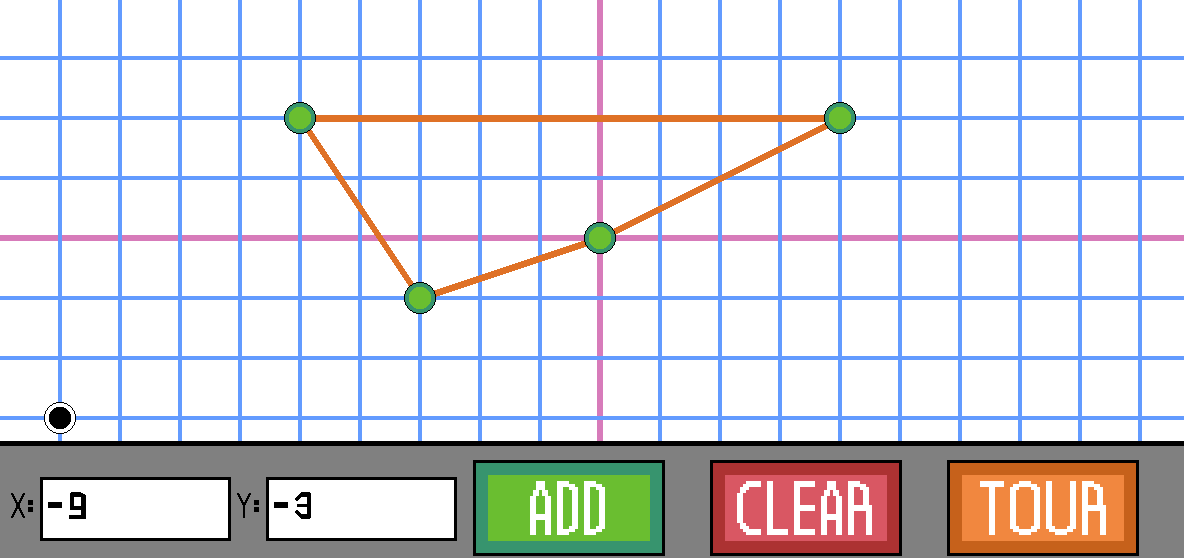
This program implements a branch and bound technique to find the optimal travelling salesperson tour for an inputted set of points. I wanted to give it a more retro feel, so I decided to do pixel art for every component, even the inputs for coordinates.
The program has a hard limit on the number of points that can be inputted, 20. It allows users to scroll vertically and horizontally through an infinite grid. The user can also add specific points using the coordinate input boxes.
To download, the release is here: https://github.com/Rajalo/TSPTourCalculator/releases/tag/v1.0
And the full repository is here https://github.com/Rajalo/TSPTourCalculator
Travelling Salesperson Approximations in Python
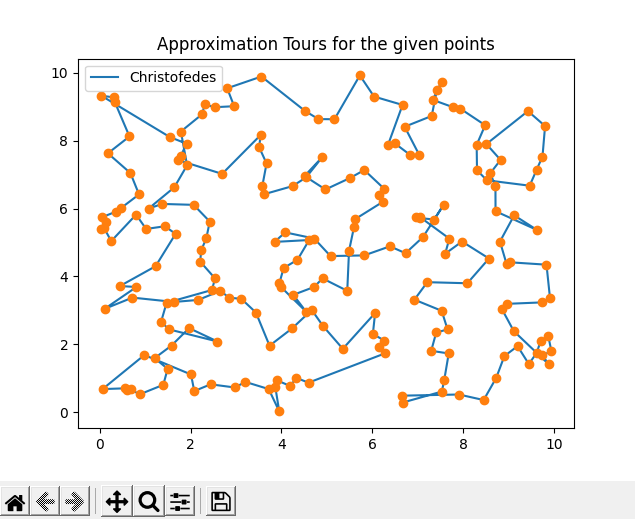
This repository is a collection of implementations of approximation algorithms for the optimal Travelling Salesperson tour for given points in the plane. I developed these implementations as part of a related research paper. Currently that paper is not complete, so I will link that here as well once that is finished.
The full repository is here https://github.com/Rajalo/TSP-Approximation-Algorithms-in-Python
Club Management Systems

This repository is a collection of Google Apps Script systems I made to help run clubs in high school and my freshman year of college. They automated some of the more mundane tasks of leadership, most centrally writing emails for notifying the membership of weekly goings-ons.
The full repository is here https://github.com/Rajalo/Club-Management-Systems
Dream Run

This is a game I made back in AP Computer Science. It's an arcade style game following a blue man's futile quest to get his jacket back from a flying trickster.
The full repository is here https://github.com/Rajalo/Dream-Run
RoseField Farms
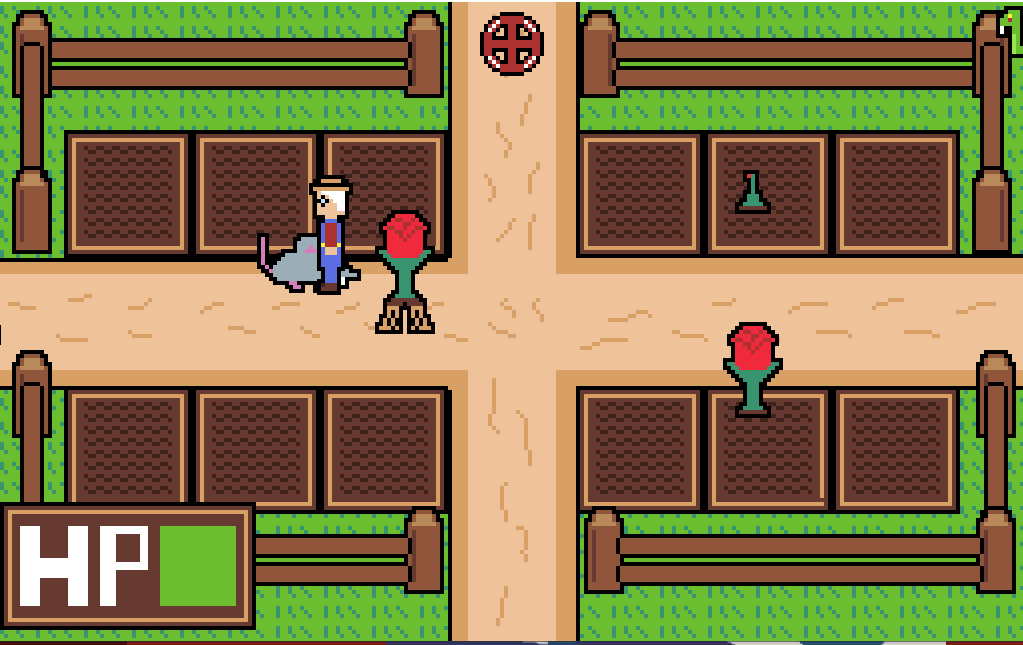
This is a game I made my freshman year of college. It's an arcade style game following a farmer's attempts to keep a rose business afloat despite the shenanigans of local animals.
The full repository is here https://github.com/Rajalo/RoseField-Farms
Pixel Art Gallery
A fun hobby I've gotten into is game development. Often I like to sketch out my ideas for games by trying to create pixel art for the game to see how I like the idea. Here are some excerpts of that work. At the end I included the pixel art from my TSP Calculator, which is on my Github.